How long does it take to sober up?
Only time sobers you up. Your liver clears alcohol at a fixed pace, so one US drink takes most adults about 2 to 3.5 hours to mostly clear, and four take about 6.5 to 12.6 hours. Coffee, a cold shower and a walk don’t lower the level.
Everyone has a trick: a strong coffee, a cold shower, fresh air, a big plate of fries, a glass of water before bed. They work on how you feel. Most of them make you more awake, and feeling awake is easy to mistake for being sober. None of them changes the pace of the liver.
What we’d do
Wait it out, and count from your last drink. If you need to be clear by a certain time, the only thing that helps is the evening before: fewer drinks, a meal first and an earlier last one. Don’t drive after drinking.
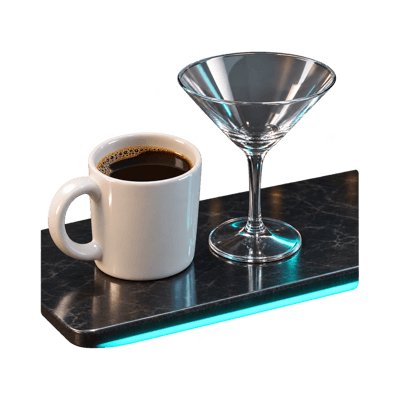
Why doesn’t coffee work?
Coffee is like turning up the radio in a traffic jam. You feel more alert, and the traffic hasn’t moved.
In a 2001 lab study, 15 adults drank alcohol with a capsule of 0, 200 or 400 mg of caffeine and then took a set of tests, including a driving simulator. Caffeine made them feel more alert and sped up their braking. It didn’t fix their balance or a second reaction test, and their braking was still slower than with no alcohol at all. The researchers wrote that caffeine “will not completely counteract alcohol impairment.”
NIAAA says the same about the other tricks: cold showers, hot coffee and walking don’t reverse the effects of alcohol.
What sets the time?
Your liver’s enzyme fills up after the first drink or two, and then the level in your blood falls by about 15 mg per 100 mL an hour on average, 10 to 20 in most people, according to a 2010 review. That pace is close to fixed. On our engine, with the drinks spread over the first hour and food not known:
| Body | 1 US drink | 4 US drinks |
|---|---|---|
| Woman, 130 lb | 3.5 hours | 12.6 hours |
| Woman, 160 lb | 2.9 hours | 10.4 hours |
| Man, 160 lb | 2.4 hours | 8.6 hours |
| Man, 190 lb | 2.1 hours | 7.4 hours |
Food is the one thing that moves it, and only if it’s in you early. In a 1994 study, men who drank right after breakfast cleared the same dose about two hours sooner than on an empty stomach. A meal eaten five hours after drinking still sped up clearing by 36 to 50%.
The level can keep rising
Alcohol still in your stomach and gut keeps entering your blood after your last drink, and NIAAA says the level can keep rising even when someone stops drinking or passes out. It’s dangerous to assume someone will be fine by sleeping it off.
If someone can’t stay awake, is breathing slowly (fewer than 8 breaths a minute) or irregularly, is vomiting, or has a seizure, call 911 right away. Those are signs of an alcohol overdose.
When will it be out of my blood?
Out of your blood
Mostly cleared about 2:50am
That's 6.8 hours from your first sip, between 2:05am and 3:55am if your liver runs faster or slower than average. About 3.8 hours of your sleep overlap it.
This is an average curve. Your own level can be higher, and it can keep rising after your last drink. Never use it to decide whether you can drive.
The signs of an alcohol overdose
Call 911 right away if someone who has been drinking has any of these:
- Confusion or stupor
- Can't stay conscious, or can't be woken
- Vomiting
- Seizures
- Slow breathing, fewer than 8 breaths a minute
- Irregular breathing, 10 seconds or more between breaths
- Slow heart rate
- Clammy skin
- No gag reflex
- Very low body temperature
- Bluish skin or paleness
Don't leave them to sleep it off. Cold showers, hot coffee and walking don't reverse an overdose. NIAAA on alcohol overdose
 18.9 g, 1.35 US drinksoz%
- 18.9 g, 1.35 US drinksoz%
 The dashed line is the myth. If your liver really cleared one US drink an hour, these drinks would be gone by 11pm. On an average liver they last until about 2:50am.
How long for N drinks?
4 US drinks spread over an hour, for your body: mostly cleared about 11 hours after the first sip (8.4 to 16.4 if your liver runs faster or slower). Started at 9pm, that's about 8:00am.
| US drinks | 1 | 2 | 3 | 4 | 6 | 8 |
|---|---|---|---|---|---|---|
| Hours from the first sip | 3.1 | 5.9 | 8.5 | 11 | 16.1 | 21.2 |
With Gyroscope One, snap or tap each drink and see what it did to your resting heart rate and sleep. How it works
For adults of legal drinking age, 21 in the US. If you're pregnant or trying, the CDC says there's no known safe amount of alcohol.
4 sources
- National Institute on Alcohol Abuse and Alcoholism, Understanding the Dangers of Alcohol Overdose, updated December 2025niaaa.nih.gov
- Liguori A, Robinson JH, Caffeine antagonism of alcohol-induced driving impairment, Drug and Alcohol Dependence, 2001pubmed.ncbi.nlm.nih.gov
- Jones AW, Evidence-based survey of the elimination rates of ethanol from blood with applications in forensic casework, Forensic Science International, 2010pubmed.ncbi.nlm.nih.gov
- Jones AW, Jönsson KA, Food-induced lowering of blood-ethanol profiles and increased rate of elimination immediately after a meal, Journal of Forensic Sciences, 1994pubmed.ncbi.nlm.nih.gov