
Alcohol and liver disease risk, with and without drinking
On this page
Liver disease from alcohol follows the dose and the habit. In a study of 6,917 Italians, liver damage started showing up above about 30 g a day, roughly two US drinks. In 401,806 British women who drank, those at 15 or more drinks a week had 3.4 times the cirrhosis risk of those at 1 or 2, and drinking daily or without food raised it further.
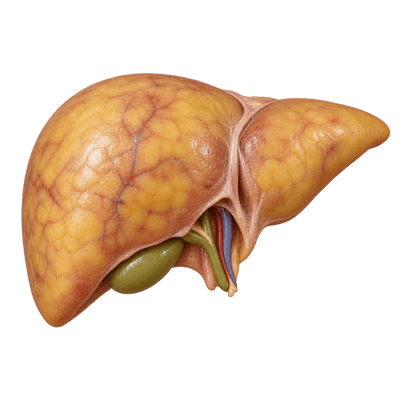
Most people think of cirrhosis as something that happens to people with a serious drinking problem. It mostly does, but the road there starts with a fatty liver that almost every heavy drinker has, and that nobody feels. The numbers below show where on that road different amounts and habits put you.
Risk of cirrhosis in 401,806 women who drank
What the numbers say
The dose. The Million Women Study asked women in their 50s and 60s how much they drank, then tracked hospital records for about 15 years. Among women who drank at least one drink a week, cirrhosis rose with every step up in weekly alcohol. Women having 15 or more drinks a week, an average of 220 g, had 3.43 times the risk of women having 1 or 2. The authors wrote that risk rose “even at moderate levels of consumption.”
The habit. At the same weekly amount, women who drank every day had 61% more cirrhosis than those who drank on fewer days. Drinking with meals lowered the risk by about 31%. Drinking daily and not with meals together came with about two and a half times the risk.
The threshold. The Dionysos study examined 6,534 people in two northern Italian towns in the 1990s and found liver damage started above about 30 g a day in both men and women. Of the people drinking more than that, 5.5% had signs of liver damage and 2.2% had cirrhosis. People who drank outside meals, or mixed several kinds of drink, had more damage.
These are relative and cross-sectional numbers, so they can’t give you one person’s lifetime odds. They do show a plain pattern: more alcohol, more often, on an empty stomach, is the hardest on the liver.
The stages, with the odds at each
NIAAA’s summary for doctors lays out how often each stage moves to the next in people who keep drinking:
| Stage | How common |
|---|---|
| Fatty liver | In about 95 to 100% of heavy drinkers |
| Inflammation | In 10 to 35% of those with fatty liver who keep drinking |
| Scarring (fibrosis) | In 20 to 40% of those with long-term inflammation |
| Cirrhosis | In 8 to 20% of those with long-term inflammation |
NIAAA says the first stage is “fully reversible if alcohol consumption stops,” and that the liver “generally does not heal from cirrhosis.”
Alcohol also causes liver cancer, which NCI lists among the cancers with “sufficient evidence.”
The trend is going the wrong way
NIAAA says cirrhosis killed about 48,000 Americans in 2019, half of them from alcohol, and the death rate from alcohol-related cirrhosis rose 47% from 2000 to 2019. A 2024 model projected the cost of alcohol-associated liver disease would more than double, from $31 billion in 2022 to $66 billion a year by 2040, with women making up a growing share.
What we’d do
Keep several dry days every week, since daily drinking is where the risk climbs fastest at a given amount. Drink with food. Keep the total well under two drinks a day. If a blood test shows raised liver enzymes, or a scan shows a fatty liver, stop drinking and retest after a few months with your doctor. The early stage clears. If you’ve been told you have cirrhosis or hepatitis, don’t drink at all.
If you drink heavily every day, talk to a doctor before you stop, because withdrawal can become dangerous. Your liver has the whole story, and ways to stop or cut back has what works.
Checked against NIAAA’s Core Resource on Alcohol (Medical Complications), the Million Women Study in The Lancet Public Health (2019) and the Dionysos study in Gut (1997), on November 15, 2026.
5 sources
- Simpson RF and others, Alcohol drinking patterns and liver cirrhosis risk: analysis of the prospective UK Million Women Study, Lancet Public Health, 2019pubmed.ncbi.nlm.nih.gov
- Bellentani S and others, Drinking habits as cofactors of risk for alcohol induced liver damage. The Dionysos Study Group, Gut, 1997pubmed.ncbi.nlm.nih.gov
- National Institute on Alcohol Abuse and Alcoholism Core Resource on Alcohol, Medical Complications: Common Alcohol-Related Concernsniaaa.nih.gov
- Julien J, Ayer T, Tapper EB, Chhatwal J, The Rising Costs of Alcohol-Associated Liver Disease in the United States, American Journal of Gastroenterology, 2024pubmed.ncbi.nlm.nih.gov
- National Cancer Institute, Alcohol and Cancer Risk, reviewed May 2, 2025cancer.gov