
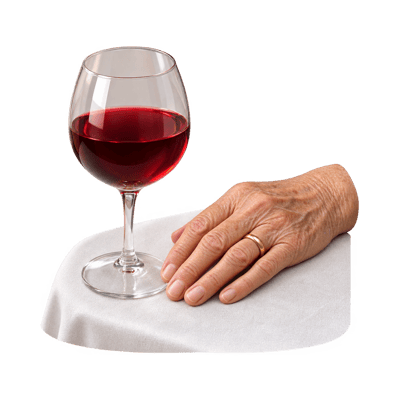
Why does alcohol hit harder as you get older?
Because your body changes. With age most people have less muscle and less body water, and alcohol spreads through body water, so the same drink reaches a higher level in the blood. NIAAA says older adults are also more sensitive to alcohol’s effects on balance, coordination and attention, which raises the risk of falls, and they take more medicines that don’t mix with it.
A lot of people notice it in their 50s and 60s: two glasses of wine that used to be nothing now leave them foggy, or they sleep worse after one. It isn’t in their heads. The body handling the drink is different.
What we’d do
Drink less than you did at 40, with food, and earlier in the evening. Ask your pharmacist about every medicine you take, including over-the-counter ones. If you’ve had a fall, or you’re on anything sedating, consider stopping altogether.
Less water, higher level
Alcohol lives mostly in body water. NIAAA explains it for women, who have less water pound for pound than men, so the same drink gives them a higher level. Aging does something similar: NIAAA says reduced muscle mass and body water mean “some older adults may reach higher blood alcohol concentrations.” The drink hasn’t changed. The tank it goes into is smaller.
More sensitive
NIAAA says older people are more sensitive to alcohol’s sedating effects and its effects on balance, coordination and attention. That puts them at higher risk of falls, car crashes and other injuries. Don’t drive after drinking, at any age.
The medicine problem
Older adults take more medicines, and many clash with alcohol. NIAAA’s examples: aspirin raises the risk of stomach bleeding with alcohol, acetaminophen can harm the liver in people who drink regularly, sedating medicines “can be deadly” with alcohol, and some blood pressure medicines and antibiotics interact too. The 2025-2030 US Dietary Guidelines say people on medicines that interact with alcohol should avoid it completely.
The long run
NIAAA says alcohol misuse can worsen conditions more common with age, like chronic pain, heart disease and diabetes, and is linked to faster cognitive decline. Drinking to sleep “can actually make sleep problems worse.” A 2026 study of 559,559 people found dementia risk rose with drinking at every level in its genetic analysis. Dementia, with and without has the numbers.
4 sources
- National Institute on Alcohol Abuse and Alcoholism, Older Adults, updated December 2025niaaa.nih.gov
- National Institute on Alcohol Abuse and Alcoholism, Women and Alcohol, updated December 2025niaaa.nih.gov
- US Department of Health and Human Services and US Department of Agriculture, Dietary Guidelines for Americans, 2025-2030, Limit Alcoholic Beveragescdn.realfood.gov
- Topiwala A and others, Alcohol use and risk of dementia in diverse populations: evidence from cohort, case-control and Mendelian randomisation approaches, BMJ Evidence-Based Medicine, 2026pubmed.ncbi.nlm.nih.gov